> For the complete documentation index, see [llms.txt](https://legacydocs.lighter.xyz/llms.txt). Markdown versions of documentation pages are available by appending `.md` to page URLs; this page is available as [Markdown](https://legacydocs.lighter.xyz/trading/binary-options/fee-structure.md).

# Fee Structure

Binary options use their own fee model, separate from the [Trading Fees](/trading/trading-fees.md) of perpetual and spot markets.

### Market fees

Each market has a maker fee and a taker fee, returned with the market's details. For Up/Down markets:

<table data-search="false"><thead><tr><th>Fee</th><th>Maximum rate</th></tr></thead><tbody><tr><td>Maker</td><td>0%</td></tr><tr><td>Taker</td><td>1%</td></tr></tbody></table>

The market fee is a **maximum rate**. The fee you actually pay is scaled down by the trade price and by your account's binary options fee multiplier.

The fee is applied to every trade, whether it opens, adds to or closes a position.

### How the fee is computed

For a trade of $$\text{size}$$ shares at an Up price $$P$$:

$$
\text{fee}
==========

\text{marketFee}
\times
\text{feeMultiplier}
\times
\text{size}
\times
P
\times
(1 - P)
$$

* $$\text{size} \times P$$ is the notional of the trade.
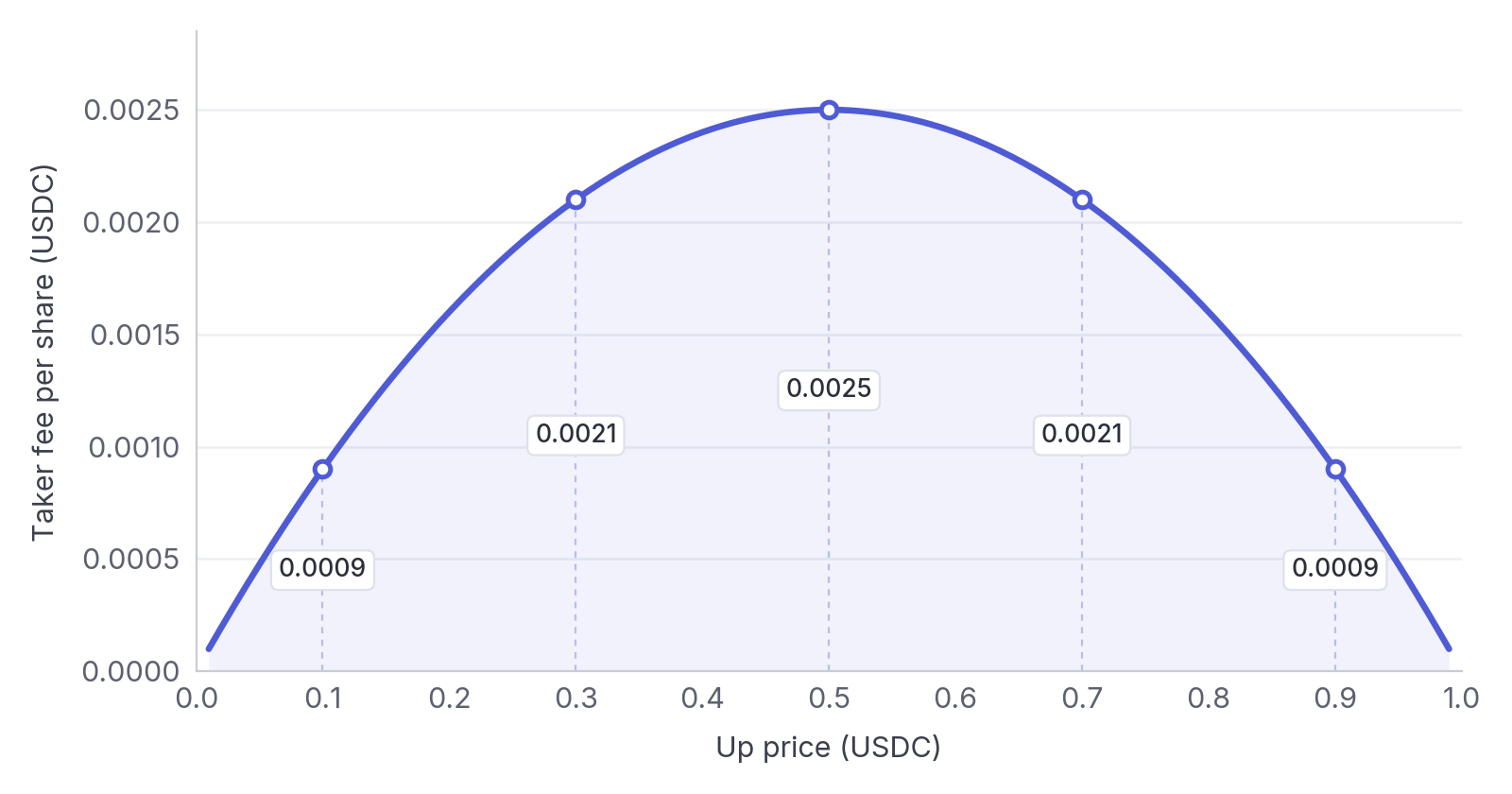
* $$(1 - P)$$ makes fees smaller when the outcome is close to certain. The fee per share is highest at $$P = 0.50$$ and falls towards zero at $$0.01$$ and $$0.99$$.
* $$\text{feeMultiplier}$$ is $$1$$ by default and is reduced by the discounts below.

The chart below shows the taker fee per share across the price range, with no discounts applied ($$\text{feeMultiplier} = 1$$):

<figure><img src="https://1186887628-files.gitbook.io/~/files/v0/b/gitbook-x-prod.appspot.com/o/spaces%2FXuISSHTfjHCg60BNss6v%2Fuploads%2FQJy1l0KRx1tuFMsiAiKj%2Fbo-taker-fee-per-share-v2.png?alt=media" alt="Taker fee per share with no discounts, by Up price"><figcaption><p>Taker fee per share with no discounts (1% taker fee)</p></figcaption></figure>

#### Example

Buying 100 Up shares at $$P = 0.60$$ as a taker, with no discount:

$$
\begin{aligned}
\text{cost}
&= 100 \times 0.60
\= 60\ \text{USDC}
\\\[4pt]
\text{fee}
&= 1% \times 1 \times 100 \times 0.60 \times (1 - 0.60)
\= 0.24\ \text{USDC}
\end{aligned}
$$

Fees are paid in USDC.

### Fees on taker orders

The fee of a single trade is predetermined: it depends only on the trade's price and size, so it is known before the trade happens. A taker order, however, can fill against several price levels of the book, and each fill is charged at its own price. The total fee of a taker order is therefore dynamic: it depends on the levels the order fills against.

For example, a taker buy of 200 Up shares that fills 100 shares at $$0.50$$ and 100 shares at $$0.60$$, with no discount:

$$
\begin{aligned}
\text{fee}\_1
&= 1% \times 100 \times 0.50 \times (1 - 0.50)
\= 0.25\ \text{USDC}
\\\[4pt]
\text{fee}\_2
&= 1% \times 100 \times 0.60 \times (1 - 0.60)
\= 0.24\ \text{USDC}
\\\[4pt]
\text{total fee}
&= 0.25 + 0.24
\= 0.49\ \text{USDC}
\end{aligned}
$$

### Fee discounts

Your fee multiplier combines two discounts, multiplied together:

$$
\text{feeMultiplier}
====================

\text{volumeMultiplier}
\times
\text{stakingMultiplier}
$$

#### Volume tiers

Based on your binary options trading volume over the last 14 days. Volume is measured as notional: $$\text{size} \times P$$ for each trade.

<table data-search="false"><thead><tr><th>Binary options volume (USDC)</th><th>Fee multiplier</th><th>Discount</th></tr></thead><tbody><tr><td>0</td><td>1</td><td>0%</td></tr><tr><td>5,000</td><td>0.95</td><td>5%</td></tr><tr><td>25,000</td><td>0.9</td><td>10%</td></tr><tr><td>100,000</td><td>0.85</td><td>15%</td></tr><tr><td>250,000</td><td>0.8</td><td>20%</td></tr><tr><td>500,000</td><td>0.75</td><td>25%</td></tr><tr><td>1,000,000</td><td>0.7</td><td>30%</td></tr><tr><td>2,000,000</td><td>0.6</td><td>40%</td></tr></tbody></table>

#### Staking tiers

Based on the LIT you have staked.

<table data-search="false"><thead><tr><th>Staked LIT</th><th>Fee multiplier</th><th>Discount</th></tr></thead><tbody><tr><td>0</td><td>1</td><td>0%</td></tr><tr><td>1,000</td><td>0.975</td><td>2.5%</td></tr><tr><td>3,000</td><td>0.95</td><td>5%</td></tr><tr><td>10,000</td><td>0.9</td><td>10%</td></tr><tr><td>30,000</td><td>0.85</td><td>15%</td></tr><tr><td>100,000</td><td>0.8</td><td>20%</td></tr><tr><td>300,000</td><td>0.75</td><td>25%</td></tr><tr><td>500,000</td><td>0.7</td><td>30%</td></tr></tbody></table>

For example, an account in the 100,000 volume tier with 10,000 staked LIT has a fee multiplier of $$0.85 \times 0.9 = 0.765$$, a $$23.5%$$ discount on the market fee. The highest tiers combined give $$0.6 \times 0.7 = 0.42$$, a $$58%$$ discount.

{% hint style="info" %}
The current volume and staking tiers are returned by the [fee tiers](https://apidocs.lighter.xyz/reference/feetiers) endpoint.

Your account's current fee multiplier is returned by the [account limits](https://apidocs.lighter.xyz/reference/accountlimits) endpoint.
{% endhint %}

### Integrator fees

Integrators in the Partner Attribution program can charge their own fee on binary options trades, the same way as on perpetual and spot markets. Integrators use the same integrator fee configuration, and users approve it the same way they do today.

Integrator fees use the same price scaling as the market fee, but fee discounts do not apply to them:

$$
\text{integratorFee}
====================

\text{integratorFeeRate}
\times
\text{size}
\times
P
\times
(1 - P)
$$

Like the market fee, the integrator fee is charged on every fill at that fill's price, and is paid in USDC in addition to the market fee.

At launch, binary options use the spot market limit, so integrator fee rates are capped at 1%. A dedicated approval process for binary options is coming soon.
